
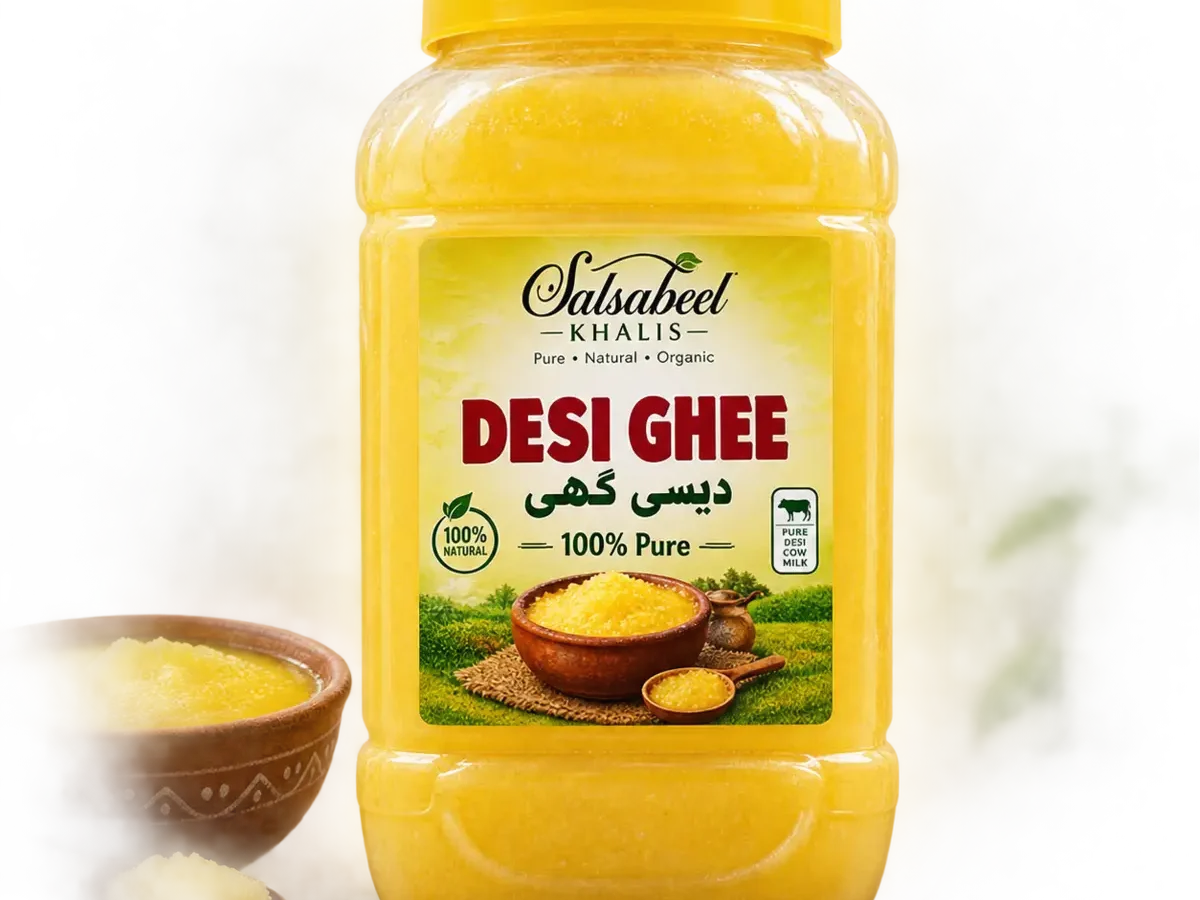
Desi ghee is the heart of Pakistani cooking — from daal tarka to sheer khurma, nothing else gives the same aroma. That is exactly why it is one of the most adulterated foods in the country. Vanaspati, refined oils, mashed potato and even animal body fat have all been found mixed into “desi ghee” sold in local markets.
Before you pay Rs. 3,000 for a kilo, you deserve to know what is actually in the jar. These five simple tests let you check pure desi ghee at home, using nothing more than your kitchen.
1. The Palm Test (Easiest)
Take a spoonful of ghee and place it on your palm. Pure desi ghee melts at body temperature — within a minute it should start turning liquid in your hand.
If it stays stubbornly solid, waxy or greasy-solid on your warm palm, it likely contains vanaspati or other hydrogenated fats, which melt at much higher temperatures.
2. The Hot Pan Test
Heat a clean steel spoon or small pan and add a teaspoon of ghee. Pure desi ghee melts quickly into a clear, golden liquid with a rich, nutty aroma. It may bubble lightly at first as residual moisture escapes, then settle.
Watch for red flags: excessive foaming that does not settle, sputtering, a burnt-plastic smell, or a dark residue left behind. Adulterated ghee — especially ghee cut with vanaspati — behaves badly under heat.
3. The Winter Granulation Test
In winter, put the jar somewhere cool (not the fridge — just a cool room). Pure desi ghee solidifies with a grainy, crystalline texture — the traditional “danedar” look our grandmothers prized. The grains should be visible and the ghee should scoop softly.
Ghee adulterated with vanaspati or refined oil either stays oily and semi-liquid, or sets into a smooth, waxy, uniform block with no graininess at all.
4. The Aroma and Taste Test
Warm a little ghee and smell it. Pure desi ghee has a deep, nutty, slightly sweet aroma that fills the kitchen — you know it the moment you smell it. Taste a drop: it should be rich and clean, with no chemical aftertaste and no flat, oily blandness.
Vanaspati-laced ghee smells faintly of nothing, or worse, carries a stale, artificial note. Once you have smelled the real thing, the fake is hard to miss.
5. The Price and Source Sense-Check
This is not a kitchen test, but it is the most practical one. Real desi ghee requires roughly 25–30 litres of milk to produce a single kilo. Nobody can sell genuine desi ghee at Rs. 800 or Rs. 1,200 per kg — the math simply does not work.
A realistic market price for pure desi ghee in Pakistan in 2026 is around Rs. 2,800–3,500 per kg. Salsabeel Khalis sells 1 kg at Rs. 3,000 (half-kg packs also available). If a deal looks impossibly cheap, it is not a bargain — it is a warning.
Also check the source: does the seller say whether it is cow or buffalo ghee? Where the milk comes from? Vague answers to basic questions are a red flag.
Common Ways Ghee Is Adulterated in Pakistan
Knowing how ghee is faked helps you understand why the tests above work. The most common tricks in Pakistani markets:
- Vanaspati mixing: The classic. Hydrogenated vegetable fat is cheap, looks similar when solid, and blends invisibly into ghee. This is what the palm test and hot pan test catch.
- Refined oil blending: Cheap palm or soybean oil mixed into ghee to stretch volume. The result stays oily in winter instead of turning danedar.
- Starch or mashed potato: Added to increase weight and mimic graininess. The iodine test (a drop of iodine turning blue-black) exposes starch, though iodine is not a typical kitchen item.
- Artificial colour and flavour: Synthetic beta-carotene for the golden colour and artificial “ghee flavour” for the aroma. These fool the eye and nose but fail the heating test — the smell turns chemical under heat.
The pattern is consistent: adulterants are chosen to fool sight and smell at room temperature. Heat, melting behaviour and price logic are much harder to fake — which is why those tests are your best defence.
Frequently Asked Questions
Cow ghee vs buffalo ghee — which is better?
Both are genuine desi ghee. Cow ghee is typically lighter golden in colour with a milder aroma; buffalo ghee is whiter, grainier and richer. Neither is “fake” — the choice is about taste preference. What matters is that the seller tells you honestly which one you are buying.
Does desi ghee need to be refrigerated in Pakistani summers?
No. Pure desi ghee is shelf-stable. Store it in an airtight steel or glass jar in a cool, dark cupboard, and always use a dry spoon — moisture is what spoils ghee, not heat. It stays good for months.
What is the shelf life of pure desi ghee?
Stored properly in an airtight container, 6–9 months easily, often up to a year. If it ever smells rancid or sour, discard it.
Why does my ghee look different in summer vs winter?
Completely normal. Ghee liquefies in summer heat and solidifies (danedar) in winter. Seasonal texture change is actually a sign of purity — heavily processed fats look identical year-round.
Buy Pure Desi Ghee Online in Pakistan
Testing is a good habit — but the simplest protection is buying from a source that is transparent about its process. Pure desi ghee from Salsabeel Khalis: traditionally prepared, honestly labelled, 1 kg for Rs. 3,000 with cash on delivery across Pakistan. For current market rates, see our desi ghee price in Pakistan guide.
Order on WhatsApp: +92-333-5447668. Buying for a restaurant, bakery or shop? Ask us about wholesale rates.

2 comments