If you have searched for the best desi ghee in Pakistan lately, you are not alone. Search data from June to September 2026 shows queries for “best desi ghee” up 90%, “desi ghee rate” up 70% and “adams desi ghee” up 150% — Pakistanis are actively comparing ghee brands and prices before buying. With commercial brands like Olper’s, Adams, Kisan and Haleeb on every shelf, and traditional khalis ghee sold online, the choice is genuinely confusing. This guide cuts through the marketing: what “best” actually means, the signs of pure desi ghee, current 2026 rates, and how to pick the right jar for your family.
What does “best” desi ghee actually mean?
The best desi ghee is simply the purest: 100% milk fat with nothing blended in — no palm oil, no vegetable ghee, no artificial flavour or colour. Traditional khalis ghee is made by slowly heating white butter (makkhan) churned from dahi, until the milk solids separate and the clear golden fat remains. That slow process is what gives real desi ghee its nutty aroma and grainy texture. A product made by merely melting generic butter oil or blending in vegetable fats may carry a “desi-style” picture on the pack, but it is not the same food — and it will not behave the same in your karahi.
7 signs of pure desi ghee (before you buy)
- Aroma: real ghee smells nutty, milky and warm — never perfumey, chemical or oddly sweet.
- Texture: at room temperature pure ghee is slightly grainy (danedar), not perfectly smooth like a cream.
- Colour: cow ghee is golden yellow; buffalo ghee is paler, almost white. Both are normal.
- Melts fast: a spoonful should begin melting in your palm within seconds.
- Behaves well on heat: it foams a little, then turns clear with light-brown residue. Excessive frothing or dark burning suggests impurities.
- Label honesty: the ingredients should read “milk fat” — nothing else. Vague phrases like “edible oil blend” are a red flag.
- Price realism: making 1kg of pure ghee takes roughly 25–30 litres of milk. If a “desi ghee” costs far less than the market rate, the maths does not work. Current rates are covered below.
Already have a jar at home? Test it with these simple checks: how to check pure desi ghee at home.
Desi ghee rate in Pakistan (2026)
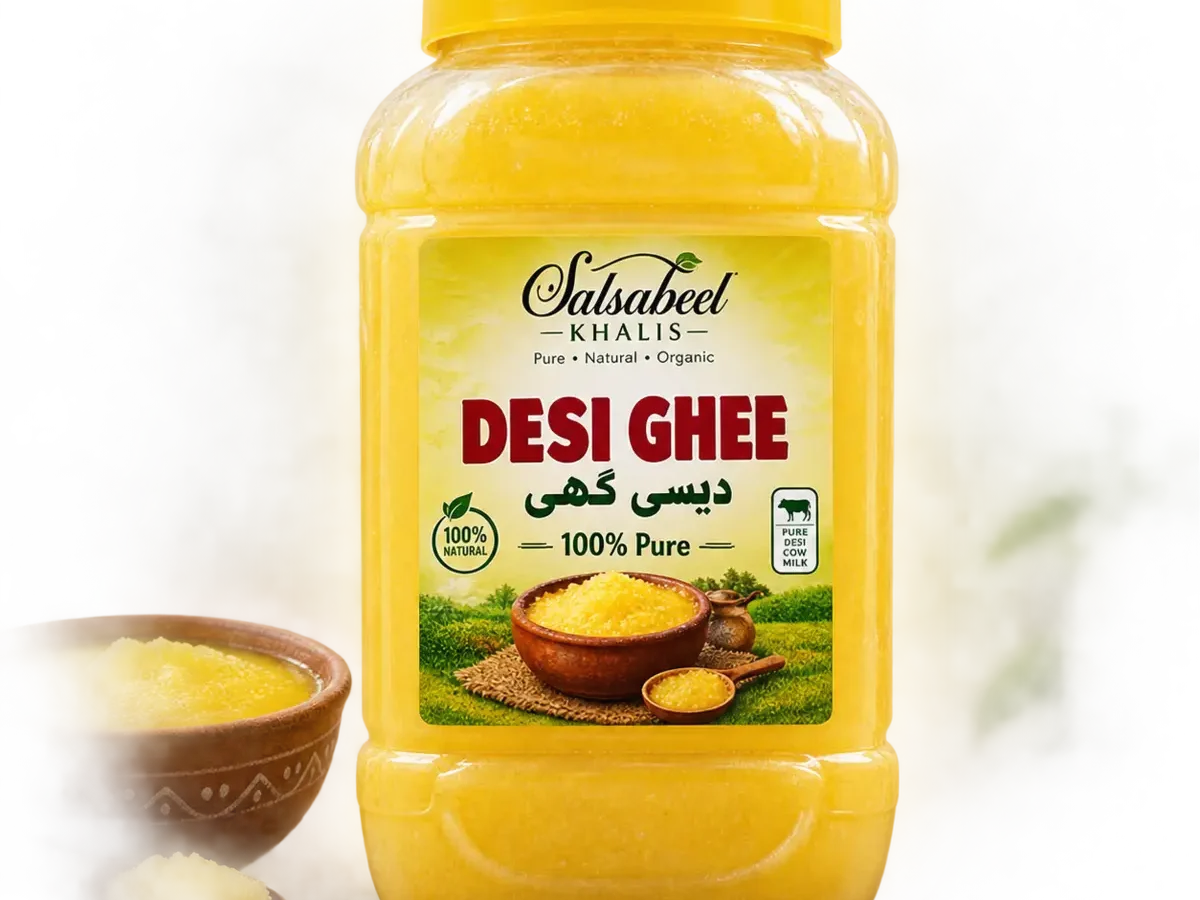
“Desi ghee price” is Pakistan’s single most-searched ghee query, so here is the honest picture: as of September 2026, pure desi ghee generally sells between Rs. 2,800 and Rs. 3,500 per kg, with 500g jars roughly half that. Commercial brands sit at the lower end of the range; small-batch khalis ghee made the traditional way sits higher, because of the sheer quantity of milk behind every kilo. Our own Salsabeel Khalis Desi Ghee is priced at Rs. 3,000 for 1kg and Rs. 1,500 for 500g. Treat any “pure desi ghee” offered far below Rs. 2,500/kg with suspicion — and any seller who cannot tell you their milk source.
Brands Pakistanis are comparing
Search interest shows exactly which names buyers are weighing up: Olper’s and Adams (Adams searches jumped 150% this quarter), alongside Kisan and Haleeb. The name “Rehmat-e-Shireen” also spiked suddenly in recent weeks — a reminder that new names trend fast online and deserve the same label-checking as established ones. Broadly speaking, commercial brands offer consistency and easy shelf availability, while traditional khalis ghee — usually sold by smaller producers online — offers the old dahi-churned method and direct traceability to the milk source. Neither category is automatically better. Judge the jar in front of you by the seven signs above, not by the logo.
Desi ghee nutrition: calories and sensible daily use
“Desi ghee calories” is one of Pakistan’s top ghee searches, so here are the plain facts: one tablespoon of ghee contains roughly 112–120 calories, almost entirely fat — mostly saturated — along with small amounts of vitamins A, D, E and K and butyric acid, a short-chain fatty acid associated with the traditional slow-heating method. Ghee is energy-dense, which is exactly why traditional Pakistani cooking uses it in small daily amounts — typically one to two teaspoons for tarka, dal or roti — rather than by the cup. One important note: ghee is a food, not a medicine. It will not cure illness, and anyone managing cholesterol or heart disease should follow their doctor’s advice on dietary fats.
How to choose: a 60-second checklist
- Ingredients list says only “milk fat”.
- Grainy texture and a natural nutty aroma.
- A sensible price for 2026 (see the rate guide above).
- The seller can tell you the milk source and method.
- Airtight, food-grade packaging with a visible manufacturing date.
Storing it right
Keep ghee in an airtight jar in a cool, dark cupboard — not next to the stove. Never dip a wet spoon into the jar; moisture is what spoils ghee, not time. Stored dry, pure desi ghee keeps for months without refrigeration, which is why our grandmothers never worried about it in summer.
Where to buy pure desi ghee online in Pakistan
If you would rather skip the guessing, our Salsabeel Khalis Desi Ghee is made the traditional slow-heated way: 1kg for Rs. 3,000 and 500g for Rs. 1,500, with cash on delivery across Pakistan. For bulk or wholesale orders, message us on WhatsApp at 0304 7832121 or visit our contact page.
Frequently asked questions
What is the best desi ghee in Pakistan?
The best ghee is 100% pure milk fat with a nutty aroma, grainy texture and honest labelling — whether it comes from a commercial brand or a traditional khalis producer. Use the checklist above to judge any jar on its own merits.
How can I check desi ghee purity at home?
Simple tests — palm melting, heating behaviour, aroma and the jar test — are explained step by step in our guide: how to check pure desi ghee at home.
What is the desi ghee rate in Pakistan in 2026?
Pure desi ghee generally ranges from Rs. 2,800 to Rs. 3,500 per kg. Prices far below this range usually signal blending with cheaper fats.