
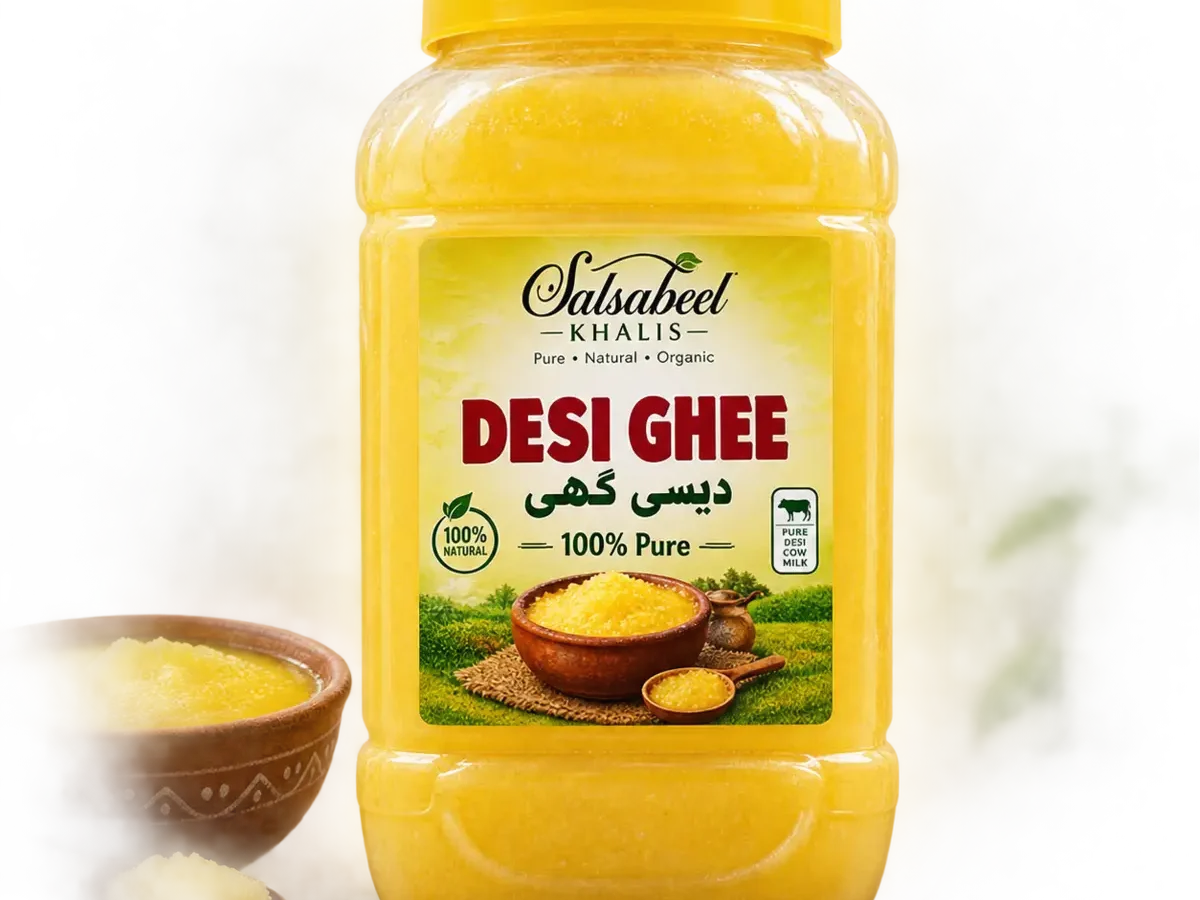
Walk into almost any Pakistani kitchen and you will find a tub or tin of banaspati sitting next to the spices. It is cheap, it is everywhere, and for decades it has been sold as the budget-friendly stand-in for desi ghee. But is banaspati really the same thing — and when you are cooking biryani, frying parathas or making kheer, does it actually matter which one you use?
This guide compares desi ghee vs banaspati the way a home cook actually experiences them: how they are made, how they taste, what experts commonly say about each, and what each costs in Pakistan in 2026. By the end, you will know exactly which one deserves a place in your kitchen.
What Is Banaspati, Exactly?
Banaspati is hydrogenated vegetable oil — usually palm or soybean oil that has been chemically treated with hydrogen so it turns solid at room temperature. It was created as a cheap substitute for desi ghee: it looks somewhat like ghee, behaves somewhat like ghee in cooking, and costs a fraction of the price.
That last point is the whole story of banaspati. It is an industrial product designed to imitate desi ghee on a budget. It is widely used in commercial bakeries, sweet shops (halwai ki dukan) and roadside food stalls because it keeps costs down — not because anyone prefers its taste.
What Makes Desi Ghee Different
Desi ghee is clarified butter: milk is cultured into curd, churned into makhan (butter), and then slowly heated until the milk solids separate and the pure butterfat remains. No chemicals, no hydrogenation, no industrial processing — just one ingredient, handled the traditional way.
That simple process is why real desi ghee has the deep, nutty aroma that fills the whole house when it hits a hot karahi. It is also why pure desi ghee costs more: a single kilo of good ghee takes a large quantity of milk to produce, while banaspati can be manufactured in bulk from cheap vegetable oils.
If you are looking for genuine, traditionally prepared ghee, pure desi ghee from Salsabeel Khalis is made the classic way and delivered across Pakistan with cash on delivery.
Taste Test: How They Perform in Real Pakistani Dishes
This is where the difference stops being theoretical and starts being obvious on the plate.
- Parathas and puris: Desi ghee gives a crisp, golden layer with a rich aroma. Banaspati fries acceptably but leaves a flat, slightly waxy taste that most people notice immediately.
- Biryani and pulao: A spoon of desi ghee stirred through rice at the end lifts the entire dish. Banaspati adds grease without the fragrance.
- Dal and tarka: The sizzle of a desi ghee tarka — with zeera, lehsan and sabut lal mirch — is the signature smell of a Pakistani kitchen. Banaspati simply cannot reproduce it.
- Kheer, halwa and meethay: Traditional sweets depend on ghee for their flavour. Ask any halwai: the premium mithai is always made in desi ghee, and you can taste the difference in the first bite.
Ask any dadi or ammi who has cooked with both, and the answer is the same: banaspati is a compromise, never a replacement.
The Health Question: What Experts Commonly Say
The biggest concern around banaspati is how it is made. Hydrogenation can create trans fats, and nutrition experts commonly advise limiting trans-fat intake as part of a balanced diet. In recent years, several countries have moved to restrict industrially produced trans fats in food — a sign of how seriously the concern is taken.
Desi ghee, by contrast, is a traditional dairy fat that people in this region have cooked with for centuries. It is commonly reported to contain fat-soluble vitamins naturally present in dairy (such as A, D, E and K), and it is a staple of traditional diets across Pakistan and India. That said, ghee is still a concentrated fat: it should be used in sensible quantities as part of an overall balanced diet, and anyone managing a health condition, taking medication, or planning major dietary changes should consult a healthcare professional first.
Neither fat is a medicine, and no cooking fat guarantees health outcomes. But when the choice is between a minimally processed traditional fat and an industrially hydrogenated one, most nutrition-minded cooks choose the traditional option.
Price Comparison (2026)
There is no pretending otherwise: banaspati is significantly cheaper than desi ghee. That is its entire selling point, and for large commercial kitchens the savings are real.
For home cooking, though, the gap is smaller than it looks, because you use less desi ghee per dish — its stronger flavour means a little goes a long way. Our pure desi ghee is currently priced at Rs. 3,000 for 1kg (down from Rs. 3,500) and Rs. 1,500 for 500g (down from Rs. 1,750). For a deeper breakdown of what drives ghee prices in Pakistan, see our desi ghee price guide.
When Does Banaspati Still Make Sense?
To be fair, banaspati has its place. Commercial bakeries, large-scale caterers and roadside stalls use it because the economics of their business demand it. If you are deep-frying hundreds of samosas a day for sale, the cost difference is hard to ignore.
But for your own family’s daily cooking — the dal, the sabzi, the breakfast parathas, the Eid sheer khurma — the flavour and traditional quality of desi ghee are worth it. Many families use a practical middle ground: desi ghee for finishing, tarka and sweets where taste matters most, and a lighter hand everywhere else.
The Verdict: Which Should You Buy?
For taste, tradition and everyday home cooking, desi ghee wins clearly. Banaspati is a budget industrial substitute; desi ghee is the real ingredient that Pakistani recipes were written around. If your budget allows it, cooking with pure desi ghee is one of the simplest upgrades you can make to your kitchen.
Ready to taste the difference? Order Salsabeel Khalis pure desi ghee — 1kg for Rs. 3,000 or 500g for Rs. 1,500 — with cash on delivery anywhere in Pakistan. Message us on WhatsApp at https://wa.me/923047832121 to place your order, and ask about our wholesale rates if you run a restaurant, bakery or food business and need bulk quantities.
Frequently Asked Questions
Is banaspati the same as desi ghee?
No. Desi ghee is clarified butter made from milk through a traditional churning and heating process. Banaspati is hydrogenated vegetable oil — an industrial product manufactured to imitate ghee’s texture at a lower cost.
Why is banaspati so much cheaper than desi ghee?
Banaspati is made from inexpensive vegetable oils (usually palm or soybean) in industrial quantities, while real desi ghee requires a large amount of milk and a slow traditional process to produce each kilo.
Can I mix desi ghee and banaspati for cooking?
Many households do mix them to balance cost and flavour — for example, using banaspati for bulk frying and adding a spoon of desi ghee at the end for aroma. It is a common compromise, though purists prefer desi ghee throughout.
How much desi ghee should I use daily?
There is no one-size-fits-all answer. Desi ghee is a concentrated fat, so most people use it in moderation as part of a balanced diet. If you have a health condition or take medication, check with a healthcare professional about what suits you.
1 comment